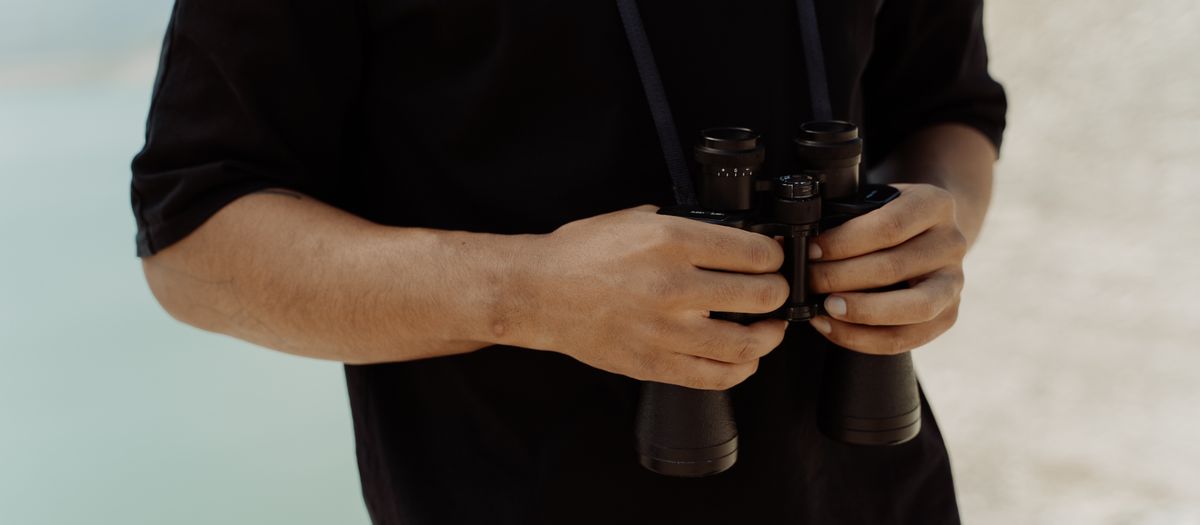
My first serious binoculars were a mistake, and I want to tell you about it before you make the same one. If you’re standing in front of a wall of binoculars — or a browser tab full of them — trying to work out which pair to start with, this is the post I wish someone had handed me at my feeder a few years back.
Why I bought too much power
I got into this the ordinary way. I put a feeder up in the backyard outside Asheville, started watching the warblers and a red-shouldered hawk that came around most mornings, and decided I wanted a “real” pair of binoculars instead of squinting.
So I did what felt obviously correct: I looked at the numbers and bought the biggest ones I could justify. A pair of 10×50s. My reasoning was airtight, I thought — 10× magnification beats 8×, 50mm objectives beat 42mm, so a 10×50 has to be the better binocular. More power, more glass, more better. I carried them out to the feeder feeling pretty clever.
That logic is exactly how a lot of people end up frustrated, and I’ll tell you why.
What actually happened in the field
The first problem was weight. A 10×50 is a genuinely heavy thing to hold up to your eyes. For a quick glance it’s fine. But birding isn’t a quick glance — it’s holding the glass up, scanning, waiting, holding some more. After a couple of minutes my arms were shaking and I was lowering the binoculars to rest, which is precisely when the bird does something interesting.
The second problem was worse, and it’s the one nobody warns beginners about: magnification multiplies your hand shake too. At 10×, every little tremor in my arms got magnified ten times right along with the bird. The image danced. A small, fast warbler that won’t sit still anyway became almost impossible to lock onto through a jittering view. I’d find the branch, lose it, find it, lose it. I kept missing the bird — the whole reason I’d bought the things.
The third problem only showed up indoors and at dusk, and it took me a while to understand it: the view wasn’t actually as bright as I expected from “more glass.” More on why in a second.
The 8×42 that fixed it
A club member at my local Audubon chapter handed me her 8×42s on a walk one morning and told me to just try them. The difference was instant and a little embarrassing.
They were lighter, so I could hold them up without my arms giving out. The lower 8× magnification meant less shake amplified, so the image sat still enough to actually track a warbler. The field of view was wider, so finding the bird in the first place was easier — I could sweep to roughly where it was and the bird was already in the circle. And, counter to everything my “more glass” logic had told me, the view looked just as bright.
That last part is the bit of physics that reframed the whole hobby for me, so let me explain it plainly.
The number that actually mattered: exit pupil
The brightness of the image your eye receives is governed by the exit pupil — the little disc of light that leaves each eyepiece. The maths is simple: exit pupil = objective ÷ magnification.
- My 10×50: 50 ÷ 10 = a 5.0mm exit pupil.
- The 8×42: 42 ÷ 8 = a 5.25mm exit pupil.
So the “smaller” 8×42 actually delivered a slightly larger exit pupil — a slightly brighter, easier image for the eye — than my big heavy 10×50. The 50mm objective wasn’t buying me a brighter view in daylight at all. It was just buying me weight.
That was the click. The number on the box that I’d treated as the whole story — magnification — was the one fighting me. The numbers that actually decided whether I’d enjoy a morning at the feeder were weight, field of view, and exit pupil. Match the binocular to how you’ll use it, not to the biggest figure printed on the barrel.
What I’d tell my past self
A few things I’d tattoo on that overconfident beginner’s arm:
- More magnification is not “better.” It is a trade. You gain reach and you lose stability, field of view, and (for a given objective) brightness per kilo of weight you carry. For handheld birding, 8× usually wins.
- Weight you can’t hold steady beats nothing. A binocular you stop raising because your arms are tired is a binocular you’re not using. A pair you can hold up for a whole walk is worth more than a bigger number you can’t keep still.
- Learn exit pupil before you spend. Objective ÷ magnification. It tells you more about the real-world view than the magnification alone ever will.
- 8×42 is the do-everything default for a reason. Light, steady, wide, bright. It’s still the pair I reach for most mornings.
That backwards lesson — buy for your use, not for the biggest number — is the entire reason this site exists. If your honest use is hikes, travel, and grab-and-go where weight is the thing that’ll actually decide whether the binoculars come with you, start with my rundown of the best compact binoculars and skip the heavy mistake I made.