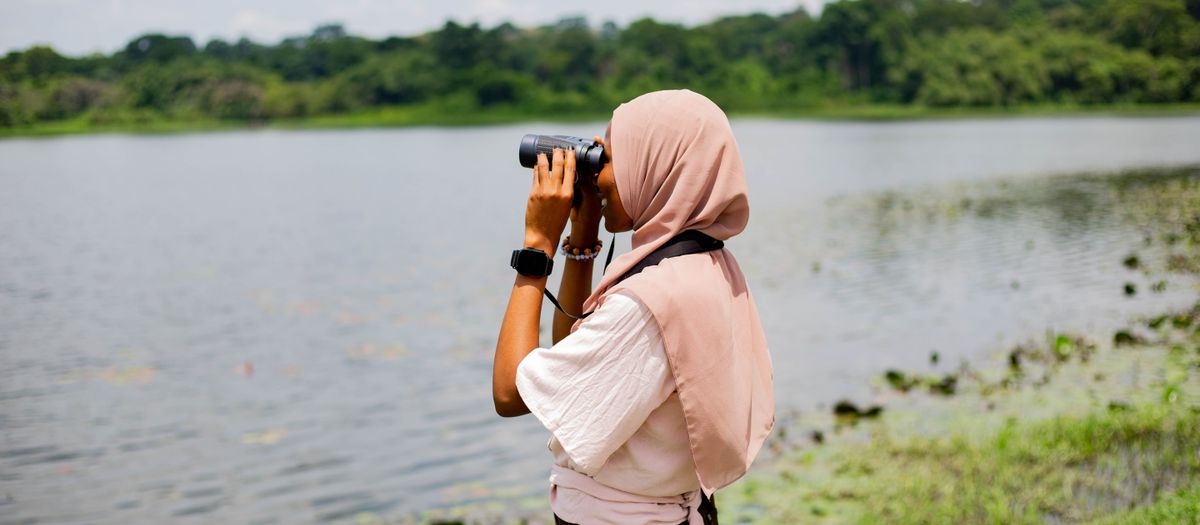
The question I get most from beginners isn’t “which binoculars?” It’s “how do I actually find the bird?” Because the frustrating bit isn’t the gear — it’s raising the binoculars, seeing a blur of leaves, and realizing the bird you spotted with your naked eye has vanished into a green wall. So here’s a real dawn walk from my patch outside Asheville, step by step, the way I actually do it.
Before I leave the porch
I set the binoculars up once and don’t fight them again all morning:
- Diopter set. The little adjustment ring (usually on the right eyepiece) corrects for the difference between your two eyes. Set it once for your eyes — close to the wrong barrel won’t matter, but a wrong diopter makes everything feel slightly soft. I set mine and forgot it years ago.
- Strap short, or a harness. A long strap lets the binoculars swing and bang. I run mine short, or use a harness on long mornings so the weight sits on my shoulders, not my neck. This is the single comfort upgrade I push hardest on beginners.
- 8×42 around the neck. My do-everything pair. Light enough to carry for hours, wide enough to find a bird, steady enough to hold it.
The order that actually finds the bird
This is the whole trick, and almost nobody tells beginners about it: find the bird with your eyes first, then bring the binoculars up to your eyes without looking away.
- See the bird with your naked eye. Movement, a flit, a shape on a branch. Lock your eyes onto it.
- Don’t look down at the binoculars. Keep staring at the bird and raise the glass straight up into your line of sight. Your hands learn to put the binoculars exactly where your eyes already are.
- The bird should be roughly in the field. This is where a wide field of view earns its money. With an 8×42’s generous field, “roughly” is good enough — the bird’s in the circle. With a high-magnification, narrow-field pair, “roughly” means an empty view and a lost bird.
- Fine-tune and focus. A quick nudge of the centre focus wheel and there it is.
Beginners almost always do it backwards — they glance down to find the eyepieces, look up, and the bird’s gone. Keep your eyes on the bird and let your hands do the work.
Why dawn, and why the gear choices follow
Dawn is when the birds are busiest and the light is thinnest, and those two facts shape everything I carry.
- The light is low, so exit pupil matters. My 8×42 gives a 5.25mm exit pupil (42 ÷ 8), bright enough to pick a warbler out of shaded branches at first light. A dimmer, higher-power pair would lose them in the gloom.
- The birds are fast, so a steady image matters. At 8× my hand shake is manageable, so I can actually track a bird that won’t sit still. I learned the hard way that 10× magnifies the wobble right along with the bird.
- I’m out for a while, so weight matters. Light glass means I keep raising it instead of letting it hang because my arms are tired.
Working the walk
Once I’m moving, a few habits do most of the work:
- Walk slow, stop often. Birds notice movement. I stop, listen, let the woods settle, and let the birds come back out.
- Listen first, look second. Half my sightings start as a sound. I face the call, get my eyes ready, and wait for the flit.
- Use the wide field to sweep. If I heard something but can’t place it, I sweep slowly with the binoculars at a likely height. The wide field covers ground fast.
- Rest the arms. Lower the binoculars between birds. Tired arms shake, and shaky arms miss.
The honest takeaway
The skill matters as much as the glass — but the glass has to get out of your way. A binocular that’s too heavy to hold steady, too narrow to find anything, or too dim for first light will fight you every step. For dawn walks and warblers specifically, that points hard at a light, wide, bright 8×42, which is exactly why it’s the birder default.
I put the full breakdown — field of view and close-focus for warblers, weight and stability over raw power, glasses-wearer eye relief — into the best binoculars for bird watching guide. Get the order right, get out at dawn, and you’ll start seeing the birds you used to lose.