I came to backyard astronomy sideways, through birding. The same 10×50s that taught me a hard lesson about handheld birding turned out to be a quietly brilliant first step into the night sky. People ask me all the time whether they should start with binoculars or jump straight to a telescope, so here’s the honest version from my own back patio outside Asheville.
A quick safety line first
Before anything else: never look at the Sun through binoculars — not even for a second. The magnified, concentrated light causes permanent, instant eye damage. Binoculars are for the Moon, the planets and the night sky, never the Sun. For solar viewing you need purpose-built, certified solar equipment, or a properly run club event. Everything below is about the night.
What binoculars actually show you
The first clear night I took my 10×50s out and pointed them at the Moon, I genuinely said “oh” out loud to an empty backyard. Here’s roughly what a decent pair of binoculars will give you.
- The Moon. This is the showstopper. You don’t see the whole disc as a flat white circle anymore — you see the line where day meets night (the terminator), and along it the craters throw long shadows. It looks three-dimensional. Binoculars are honestly one of the best ways to enjoy the Moon because you get the whole disc in a wide, bright field.
- Jupiter’s moons. Point at Jupiter and you’ll see it as a tiny bright disc with up to four pinpricks of light strung out in a line beside it. Those are the Galilean moons. Come back the next night and they’ve shifted — you’re watching a little solar system tick over. The first time they lined up for me I was hooked.
- Star clusters. The Pleiades go from a fuzzy smudge to a glittering little dipper of blue-white stars. Open clusters like the Beehive resolve into dozens of points. Binoculars’ wide field is perfect for these — a telescope often zooms in too far to fit the whole cluster.
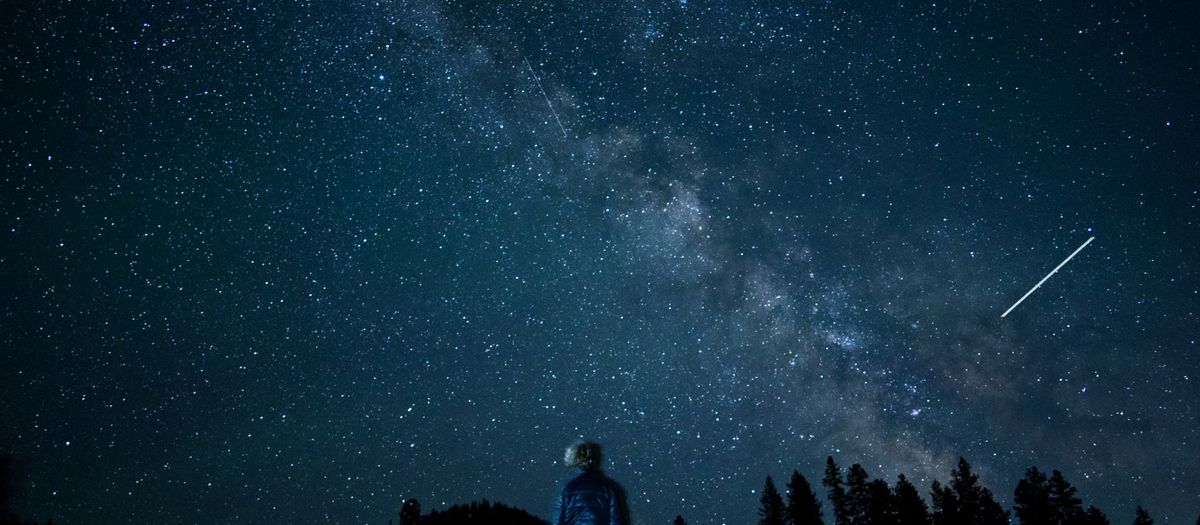
- The Milky Way. From a dark-ish site, sweeping the summer Milky Way with binoculars is one of the great quiet pleasures of the hobby. Star fields you didn’t know were there.
What binoculars don’t show you
I’ll be straight with you, because over-promising is how people get disappointed.
- No planetary detail. You will not see Saturn’s rings as rings or Jupiter’s cloud bands through binoculars. Saturn looks like a slightly stretched dot. That detail needs a telescope’s magnification.
- No big, bright deep-sky close-ups. Faint galaxies and most nebulae are dim smudges at best in binoculars. A telescope gathers more light and magnifies more.
- The view is small and wide, not zoomed in. That’s a feature for clusters and the Moon, and a limitation if what you pictured was a hands-on close-up of Mars.
So where a telescope wins
A telescope is the right tool when you want magnification and light grab: Saturn’s rings, Jupiter’s bands, the polar caps on Mars, fainter deep-sky objects pulled out of the dark. It also asks more of you — setup, alignment, a learning curve, more weight, more money, and a fussier night when you’d rather just look up. Telescopes are a whole hobby of their own (it’s a big enough topic that it has its own sibling site).
Why I tell beginners to start with binoculars
Here’s my honest, slightly unfashionable opinion: most people should buy binoculars first, even if a telescope is the eventual goal.
- They’re instant. Pick them up, point, look. No alignment, no cool-down, no tripod required for the Moon and clusters.
- They show you the sky. You learn the constellations, you learn to star-hop, you build the map in your head that a telescope needs you to already have.
- They do double duty. The same pair is birding glass by day. A telescope only does the one job.
- They’re cheaper to be wrong with. If astronomy doesn’t grab you, you’ve still got a useful pair of binoculars.
For night-sky use specifically, the rules flip a bit from birding — bigger objectives and exit pupil matter more, and a tripod becomes your friend once you go past 10×50. I put the whole breakdown of configs, exit pupil under dark skies, and when a tripod becomes mandatory into the best binoculars for stargazing guide. Start there, get out under a clear night, and find Jupiter’s moons for yourself — it’s the easiest “wow” in the hobby.